

Egypt Economic Outlook 2027: 7 Trends International Companies Should Watch
The Egypt economic outlook for 2027 shows stronger economic momentum, but the picture is still mixed.
Growth has recovered, private investment is rising, inflation is expected to decline, and Egypt continues to attract international companies in manufacturing, technology, and business services.
At the same time, high interest rates, currency exposure, regional instability, and the pace of economic reform remain at important risks.
For international companies, the Egypt economic outlook for 2027 is not simply about GDP growth. The real question is what these changes mean for operating, investing, or expanding in Egypt.
Here are seven developments worth watching.
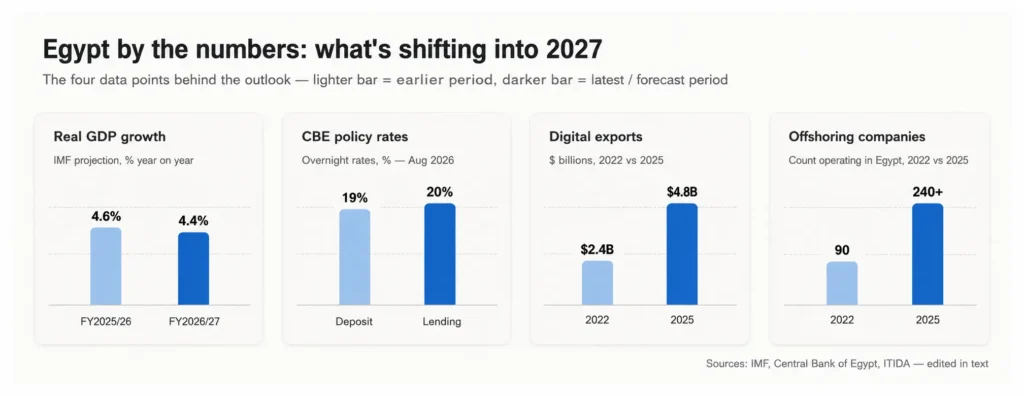
Figure: the four headline stats behind this outlook, at a glance.
1- Economic growth remains positive
The International Monetary Fund expects Egypt’s real GDP to grow by around 4.4% in FY2026/27, following projected growth of about 4.6% in FY2025/26. (imf.org)
That is notable given the pressures Egypt has faced from inflation, currency adjustments, high energy costs and regional instability.
But the headline GDP figure only tells part of the story.
Manufacturing, tourism, telecommunications, and private investment have all contributed to recent growth. (mped.gov.eg)
For companies looking at Egypt, the important question is therefore not just whether the economy is growing, but which sectors are growing and where the opportunities are.
2- Inflation could become easier to manage
Inflation has affected almost every part of doing business in Egypt, from salaries and supplier costs to rent and consumer spending.
There are signs that this could improve in 2027.
In August 2026, the Central Bank of Egypt projected that inflation would decline gradually from the first quarter of 2027 and move toward its 7% ±2 percentage-point target during the second half of the year. (cbe.org.eg)
If inflation continues falling, companies could gain more predictable operating costs and better visibility when budgeting.
Risks remain. Energy prices, exchange-rate movements, fiscal measures, and regional events could all affect the outlook.
For companies building a multi-year business case for Egypt, inflation should remain one of the main indicators to watch.
3- Interest rates are still high
Lower inflation could eventually allow interest rates to fall, but financing conditions remain tight.
As of August 2026, the Central Bank’s overnight deposit and lending rates stood at 19% and 20%. (cbe.org.eg)
For foreign companies funding Egyptian operations from abroad, this may not be a major issue.
For businesses relying on local borrowing, working capital or debt-funded expansion, it matters much more.
High rates can also slow investment and consumer spending across the wider economy.
One of the main signals to watch in 2027 will therefore be when, and how quickly, the Central Bank begins easing monetary policy.
4- The Egyptian pound remains a key variable
Any serious Egypt economic outlook needs to account for the exchange rate.
Egypt has moved toward a more flexible exchange-rate system as part of its economic reform programme. The IMF continues to view exchange-rate flexibility as important for maintaining economic stability. (imf.org)
But currency movements affect different businesses in different ways.
A European company earning in euros and paying Egyptian salaries in EGP has a very different exposure from a company importing machinery or products in foreign currency.
Companies should therefore look at:
- where their revenue comes from;
- which currencies contracts are priced in;
- how much of their cost base is local;
- how dependent they are on imports;
- how profits will move between markets.
Predicting an exact EGP/USD rate is less useful than understanding how sensitive your business model is to currency movements.
5- Private-sector growth is becoming more important
One of the biggest changes to watch is the role of the private sector.
During the first quarter of FY2025/26, private investment grew 25.9% and accounted for around 66% of total executed investment, according to Egypt’s Ministry of Planning. (mped.gov.eg)
Egypt is trying to move toward an economy where private businesses play a larger role in investment and growth.
Its wider economic strategy includes reducing public investment in some areas, attracting foreign capital, and supporting higher-value, export-oriented industries. (mped.gov.eg)
However, progress is not complete.
The IMF noted in July 2026 that reducing the state’s economic footprint and progressing with the divestment programme had been slower than anticipated. (imf.org)
For international companies, 2027 will be about whether those reforms translate into easier market access, greater competition, and more room for private investment.
6- Egypt is targeting specific types of foreign investment
Egypt is actively trying to attract more foreign capital, particularly into sectors that can create exports, technology, and higher-value jobs.
Its Foreign Direct Investment Strategy for 2025–2030 highlights areas including industry, technology, renewable energy, and tourism. (mped.gov.eg)
That creates several possible business cases.
Manufacturers may view Egypt as a production and export base. Technology companies can use it as a regional delivery hub. Renewable-energy investors are evaluating its energy potential, while logistics businesses benefit from Egypt’s position between Africa, Europe, Asia and the Middle East.
This is an important distinction.
Entering Egypt to sell to Egyptian customers is one opportunity.
Using Egypt as a base to serve other markets is another.
For some international companies, the second may be more attractive.
7- Technology and business services continue to grow
Egypt’s ICT and global business-services sector is becoming increasingly important.
Digital exports reached around $4.8 billion in 2025, up from $2.4 billion in 2022. During the same period, the number of offshoring companies operating in Egypt grew from around 90 to more than 240. (itida.gov.eg)
Egypt also hosts more than 270 global service delivery centers serving international markets across software development, IT services, business processes, and engineering R&D. (itida.gov.eg)
This means international companies are increasingly looking at Egypt not only as a market, but as a place from which they can operate.
For companies facing talent shortages, high European operating costs or the need for additional delivery locations, this is a trend worth watching closely.
The biggest wildcard: regional instability
Egypt’s location creates major economic advantages, but also exposure to regional events.
Conflict in the Middle East has affected energy prices, investor confidence, and traffic through the Suez Canal.
The IMF expects a gradual recovery in Suez Canal revenues to support Egypt’s external position, while warning that renewed regional escalation remains a significant downside risk. (imf.org)
For businesses, the effects can spread quickly through shipping costs, energy prices, inflation, and currency movements.
Regional developments should therefore remain part of any Egypt market-entry scenario.
What to Watch in Egypt’s Economic Outlook?
Companies do not need to follow every economic announcement coming out of Egypt.
Seven indicators will tell much of the story:
- Inflation: Is it still falling?
- The Egyptian pound: Is the exchange rate becoming more stable?
- Interest rates: When does monetary policy begin to ease?
- Private investment: Is private sector activity continuing to grow?
- Economic reform: Is the state’s role in the economy actually declining?
- FDI and exports: Which sectors are attracting international investment?
- Regional stability: Are Suez Canal activity and investor confidence improving?
Together, these indicators provide a much clearer view of where Egypt’s business environment is heading.
What the Egypt economic outlook cannot tell you
Economic data can tell you whether Egypt is moving in the right direction.
It cannot tell you whether Egypt is the right market for your company.
That requires more specific questions.
Who are your customers? Who are your competitors? What will operating locally cost? What regulations affect your industry? Should you establish a company, use an Employer of Record, work with a local partner, or test the market first?
That is where economic research becomes a market-entry strategy.
At CrossWorkers, we help international companies assess those questions before making major commitments in Egypt, from understanding the market to establishing and operating locally.
Considering Egypt in 2027? Explore your options before deciding how to enter the market.

The Western World’s Tech Solutions in Eastern Europe Need Alternatives
The current Russian invasion of Ukraine and the imposed sanctions by Russia and Belarus created a situation where a large IT labor workforce got removed for an unspecified period. And the Russian war on Ukraine threatens to destroy the Ukrainian IT...

We’re at ICT Germany 2023 Event!
IT Creation & Operations Germany Forum + IT Service Delivery Forum As CrossWorkers is an industry partner to this year's event, we're inviting you to visit our booth and attend the annual double strategy forum on IT operations and ICT service delivery by The...

Software development offshoring. All that you need to know! Part 2
Software development offshoring. All that you need to know! Part 2 Outsourcing and remote work is becoming the new norm around the world. And as we mentioned in the previous article - go check-, that there are some misconceptions about the word "outsourcing"....
Phone: (+45) 70 27 20 40 E-mail: info@crossworkers.com
Telefon: (+45) 70 27 20 40
E-mail: info@crossworkers.com