

Egypt vs Morocco: How the Two North African Business Hubs Compare
For international companies considering expansion into North Africa, Egypt and Morocco often end up on the same shortlist.
Both countries offer access to European markets, growing business ecosystems, established outsourcing industries, and opportunities for foreign investment. Both have also spent years positioning themselves as attractive locations for international companies.
But they offer different advantages.
Morocco has developed strong connections with European manufacturing and supply chains. Egypt, meanwhile, offers a much larger domestic market, a substantial talent pool, and opportunities to build operations serving the Middle East, Africa, and Europe.
For companies considering doing business in Egypt or Morocco, the decision depends on what they actually want to achieve.
Are they looking for customers? A regional sales presence? A development team? A manufacturing base?
The answers can point to very different locations.
Egypt vs Morocco: A quick business comparison

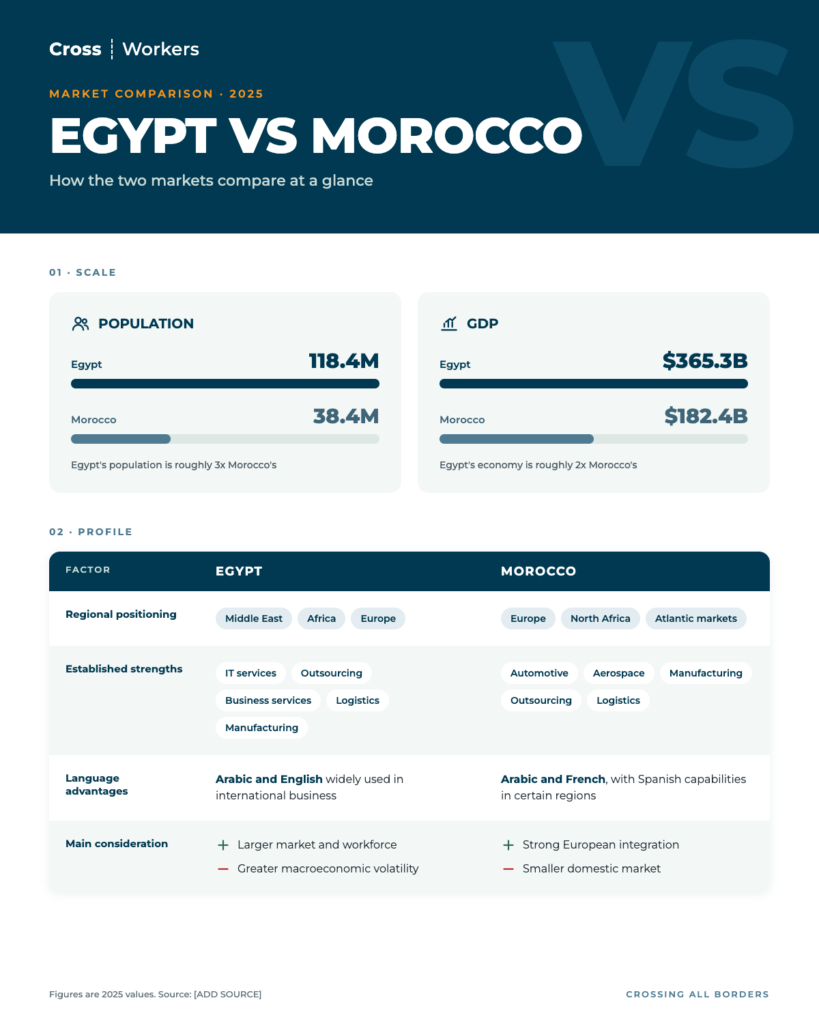
Economic figures: World Bank, 2025.
These differences are worth examining beyond the headline numbers.
1. Market size: Egypt has the scale, but size alone doesn’t guarantee sales
Egypt’s most obvious advantage is its population.
With approximately 118 million people, it has more than three times Morocco’s population of around 38 million.
For companies selling products or services locally, that represents a substantially larger potential customer base.
Consumer goods, healthcare, education, technology, financial services, and business-to-business solutions can all find opportunities in a market of that size.
But population figures only tell part of the story.
A market with millions of potential customers does not necessarily translate into millions of paying customers. Purchasing power, price sensitivity, distribution, competition, and customer behavior still determine whether an opportunity is commercially viable.
Morocco, despite its smaller population, has a higher GDP per capita. According to World Bank figures for 2025, it stood at approximately $4,673, compared with $3,086 in Egypt.
That distinction matters for companies deciding which customers they can realistically serve and at what price.
The practical difference: Egypt offers greater domestic market scale. Morocco may be attractive to businesses targeting more specific customer segments or using the country primarily as a base for exports and international operations.
For companies considering Egypt, the next question should be whether their product or service can find paying customers within that larger market.
That is where market validation becomes essential.
2. Access to international markets: Different geographical advantages
Both Egypt and Morocco occupy strategic locations, but geography works differently for each country.
Morocco’s proximity to Spain and the wider European Union has contributed to its development as a manufacturing and export hub.
Automotive production, aerospace, textiles, and logistics have benefited from established industrial ecosystems and relationships with European buyers.
In 2025, trade in goods between Morocco and the EU reached approximately €62.2 billion, according to the European Commission.
For European manufacturers looking to shorten supply chains or establish production closer to their existing operations, Morocco has a strong proposition.
Egypt offers a different kind of regional reach.
Its location connects the Mediterranean, the Middle East, Africa, and international shipping routes through the Suez Canal.
For companies planning to serve Egyptian customers while exploring opportunities in the Gulf or other African markets, that position can be commercially relevant.
Egypt also has an established trade relationship with the EU, with bilateral goods trade reaching approximately €32.3 billion in 2025.
However, geographical access should not be confused with automatic market access. Trade rules, distribution networks, customs requirements, and local regulations still differ between destination markets.
The important distinction is what each location enables a business to do.
Morocco is particularly well positioned for companies closely integrated into European production and distribution networks. Egypt can be attractive for companies looking to combine local market opportunities with a broader regional business presence.
3. Talent and business services: Two established outsourcing markets
For companies expanding internationally, access to skilled employees can be just as important as access to customers.
Both countries have developed substantial outsourcing industries, although their strengths reflect different business relationships.
Morocco has built an established sector covering customer relationship management, business process outsourcing, IT outsourcing, engineering services, and knowledge-based operations.
Its French-speaking workforce and close business connections with European markets make it particularly relevant for companies serving France and other French-speaking customers.
Egypt has developed a broad international services industry spanning software development, IT operations, customer support, finance, engineering, and business processes.
According to Egypt’s Information Technology Industry Development Agency (ITIDA), offshoring exports reached approximately $5.2 billion in the 2025/26 financial year, with around 195,300 people employed in exporting companies across the sector as of June 2026.
The industry increasingly supports higher-value technical and business functions, rather than traditional contact center operations alone.
For European companies, Egypt presents the possibility of building dedicated teams that work directly with their existing organizations.
This might involve recruiting software engineers, establishing a customer support operation, building a finance function, or hiring local business development employees.
Language requirements will influence the choice. A company requiring French-language customer support may naturally look toward Morocco. A company building an English-speaking software development team may find Egypt particularly relevant.
Neither country is automatically the better outsourcing destination.
The right choice depends on the roles, required skills, languages, management expectations, and how the new employees will work with the existing business.
4. Operating costs: Look beyond salary comparisons
Cost is often one of the first factors companies compare when considering Egypt and Morocco.
But comparing average salaries rarely gives an accurate picture of what operating in either market will actually cost.
A business also needs to account for recruitment, employee benefits, office space, taxes, social insurance, accounting, administrative requirements, currency exposure, and ongoing compliance.
Macroeconomic conditions matter too.
According to World Bank data, annual consumer price inflation in 2025 was approximately 14.1% in Egypt, compared with 0.7% in Morocco.
That difference illustrates a real consideration for companies budgeting in Egypt: costs and exchange rates need to be monitored rather than assumed to remain constant.
Morocco offers a different economic environment, although its operating costs still vary considerably by city, industry, required skills, and business model.
For companies doing business in Egypt, the potential for cost efficiency is meaningful, particularly when building local teams or service operations. But those savings need to be assessed against the full cost of operating.
A business should calculate the total annual cost of its intended operation in both countries, not simply compare the salary of one employee.
5. Business setup: How difficult is it to establish a presence?
Choosing a country is one decision. Establishing a functioning business there is another.
Both Egypt and Morocco have introduced measures intended to facilitate investment and business establishment.
In Egypt, the General Authority for Investment and Free Zones (GAFI) provides investor services and electronic incorporation options for eligible company structures.
Morocco has regional investment centers and investment support measures designed to assist businesses establishing operations.
Yet incorporating a company does not automatically mean that the business is ready to operate.
Depending on the activity, companies still need to address banking, taxation, licensing, employment, payroll, regulatory compliance, and local suppliers.
And there is another question worth asking before going through that process:
Does the company need a legal entity from the beginning?
For some businesses, the answer is yes. Their activity, licensing requirements, contracts, or commercial model may require it.
Others may be able to begin with a more limited presence.
For example, a European company interested in selling industrial equipment in Egypt might first identify potential distributors and meet prospective customers before committing to an office.
A technology company might initially need only a small locally employed team.
A business services provider might benefit from local representation while testing demand.
These are different requirements, and they do not all justify the same level of investment.
Where legally and commercially appropriate, companies can explore entering Egypt without immediately establishing their own entity.
The goal is to match the market-entry structure to the actual business requirement.
6. Doing business in Egypt: Where are the opportunities and challenges?
For companies considering Egypt, the potential extends beyond its domestic consumer market.
There are several ways an international company can approach the country.
One is to enter the Egyptian market to sell products or services. This requires understanding demand, local purchasing behavior, distribution channels, potential customers, and competition.
Another is to build a local team. Egypt’s talent market creates opportunities for companies that want dedicated employees without necessarily relocating or expanding their existing European office.
A third is to establish local operations supporting regional or international business activities. This could involve administrative functions, customer operations, technology services, or a dedicated business unit.
Some companies may combine these approaches, using Egypt as both a commercial market and an operational location.
But challenges should not be overlooked.
Companies need to account for economic volatility, administrative procedures, regulatory requirements, and the practical differences involved in managing an international operation.
They also need local market knowledge.
Understanding who makes purchasing decisions, which distribution relationships matter, how to recruit suitable employees, and what operational requirements apply can make a significant difference to the success of an expansion.
These are not always questions that can be answered through desktop research.
7. Egypt or Morocco: Which market makes more sense for your business?
There is no universal winner between Egypt and Morocco.
A European automotive supplier looking to establish production close to existing European supply chains may find Morocco particularly attractive.
A company requiring extensive French-language customer operations may also have good reasons to prioritize Morocco.
On the other hand, an international technology company looking to build a dedicated development team might find Egypt worth exploring.
A business seeking access to a larger domestic market, potential local partners, or opportunities across Egypt and the wider Middle East may also see a stronger commercial case for Egypt.
The decision becomes clearer when companies stop comparing countries in general terms and start examining what their own business needs.
Before committing, they should be able to answer a few practical questions:
- Is the objective to sell, recruit, manufacture, or establish operations?
- Who are the actual target customers?
- What local skills, languages, and resources will be required?
- How much investment is needed before meaningful results can be measured?
- Can the business validate demand or build an initial presence before committing to a full setup?
Answering these questions is more useful than choosing a country based on general investment rankings.
Where CrossWorkers fits into the picture
For international companies considering Egypt, the challenge is often less about recognizing the opportunity and more about understanding how to approach it.
A company may be interested in the Egyptian market but lack the local contacts needed to identify customers or distributors.
Another might want to hire employees but have no local HR, payroll, or administrative infrastructure.
Others may be ready to establish a legal entity but need support managing everything that follows company registration.
At CrossWorkers, we have spent 17 years working in Egypt, connecting international businesses with local talent, operations, and business opportunities.
Our Business Services support companies at different stages of market entry, from initial exploration to established operations.
This includes market research and validation, local representation, partner and customer search, recruitment, Employer of Record services, company formation, workspace solutions, and operational support.
There is no reason every business should enter Egypt in exactly the same way.
Some need to explore the market first. Others are ready to build a team or establish a permanent presence.
If Egypt is on your expansion shortlist, contact CrossWorkers. We can help you evaluate your opportunities, understand the local requirements, and choose an approach that makes commercial sense for your business.
Europe’s IT Talent Shortage and Why Egypt Is Emerging as a Solution
(+45) 70 27 20 40info@crossworkers.com Across Europe, the IT talent shortage has become one of the most pressing challenges for businesses in 2025. Despite increased investment in education, recruitment, and digital transformation, companies continue...

International Business Expansion: 5 Reasons Companies Expand Internationally
Businesses rarely grow by standing still. As markets evolve and competition increases, companies begin looking beyond their domestic borders to unlock new growth opportunities. For many organizations, particularly SMEs, international business expansion becomes a...

Expanding into Egypt: How European Companies Can Enter a New Market with Confidence
(+45) 70 27 20 40info@crossworkers.com YExpanding into a new market is rarely about ambition alone. It’s about timing, local understanding, and having the right people beside you when the unknowns appear. For many European companies, Egypt is becoming...
Phone: (+45) 70 27 20 40 E-mail: info@crossworkers.com
Telefon: (+45) 70 27 20 40
E-mail: info@crossworkers.com