

Business in North Africa: Why International Companies Are Taking a Closer Look
North Africa is not new to international business. What is changing is the role the region can play.
Companies are looking more closely at where they manufacture, where they hire, where they deliver services from, and which markets they want to enter next.
However, supply-chain resilience matters more. Access to skilled people matters more. Being closer to customers matters more.
Against that backdrop, business in North Africa is becoming increasingly difficult to ignore.
Why business in North Africa is attracting more attention
Investment data gives us one indication.
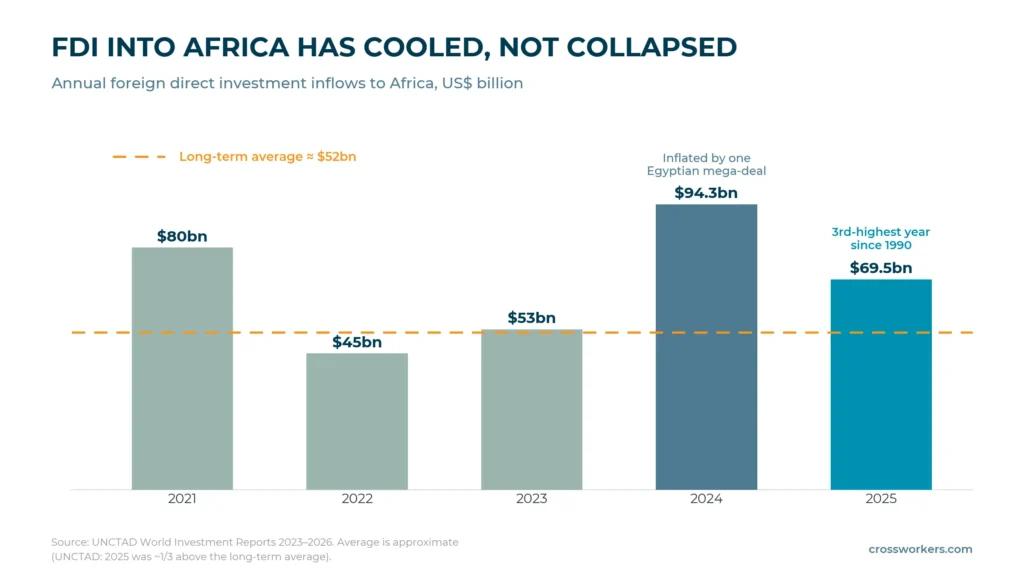
Foreign direct investment into Africa reached around $70 billion in 2025. While that was below the unusually high level recorded in 2024, it was still the continent’s third-highest level since 1990 and roughly one-third above its long-term average. North Africa remained Africa’s largest recipient subregion, with Egypt receiving around $15 billion and remaining the continent’s largest individual recipient.
The 2024 numbers need some context. North African FDI had jumped dramatically to $51 billion, but much of that increase came from one very large Egyptian project.
Even after accounting for exceptional deals, however, investment activity across Africa remained stronger than the headline distortion might suggest.
Geography is becoming an operational advantage
Open a map, and North Africa’s position becomes difficult to miss.
Europe sits directly across the Mediterranean. The Gulf is to the east. Sub-Saharan Africa is to the south. Major Mediterranean and Red Sea trade routes run through or alongside the region.
That matters differently depending on the business.
For a manufacturer, proximity can shorten supply chains. For a technology company, overlapping working hours can make international teams easier to manage. For a company entering Africa or the Middle East, a North African operation can also provide access to several markets rather than serving only one.
Morocco is a good example of how this proximity can turn into real economic integration. In 2025, Morocco exported more than $16 billion in vehicles and vehicle-related products, with France, Spain, Italy, and Germany among its biggest destinations.
Infrastructure is supporting more serious investment
Location alone does not make a business hub.
Companies also need roads, ports, power, connectivity, and the infrastructure required to operate reliably.
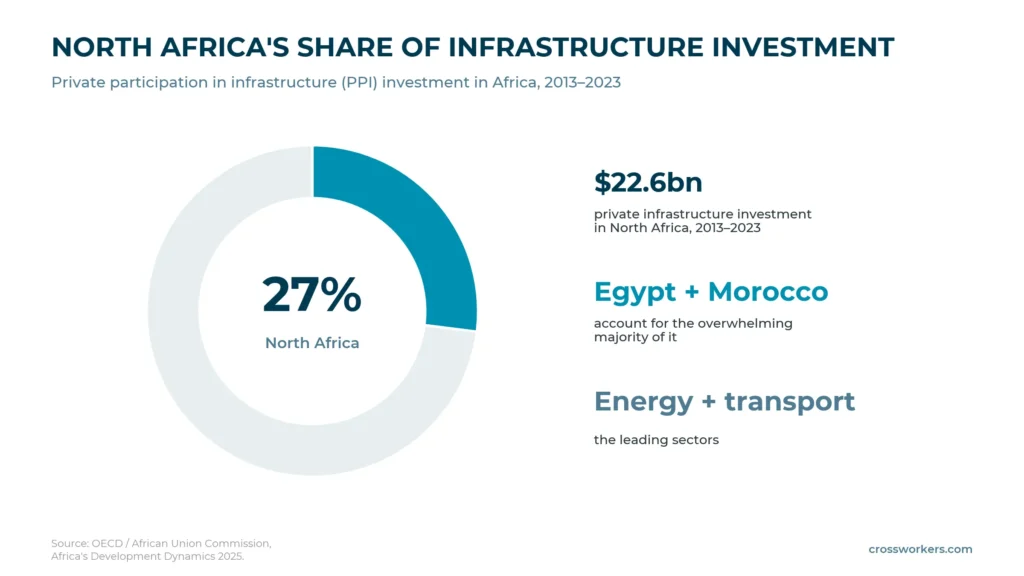
North Africa performs relatively strongly here compared with much of the continent. According to the OECD and African Union Commission, the region attracted 27% of Africa’s private participation in infrastructure investment between 2013 and 2023, representing $22.6 billion.
Egypt and Morocco accounted for the overwhelming majority of that investment, particularly across energy and transport.
There is still a substantial infrastructure gap, and the region is far from finished developing. But that investment matters because it changes what companies can realistically build there.
Talent is becoming part of the investment story
Another shift is happening at the same time.
North Africa is not only attracting companies that want to make or sell physical products. International companies are increasingly using the region to deliver services.
Egypt is particularly interesting here.
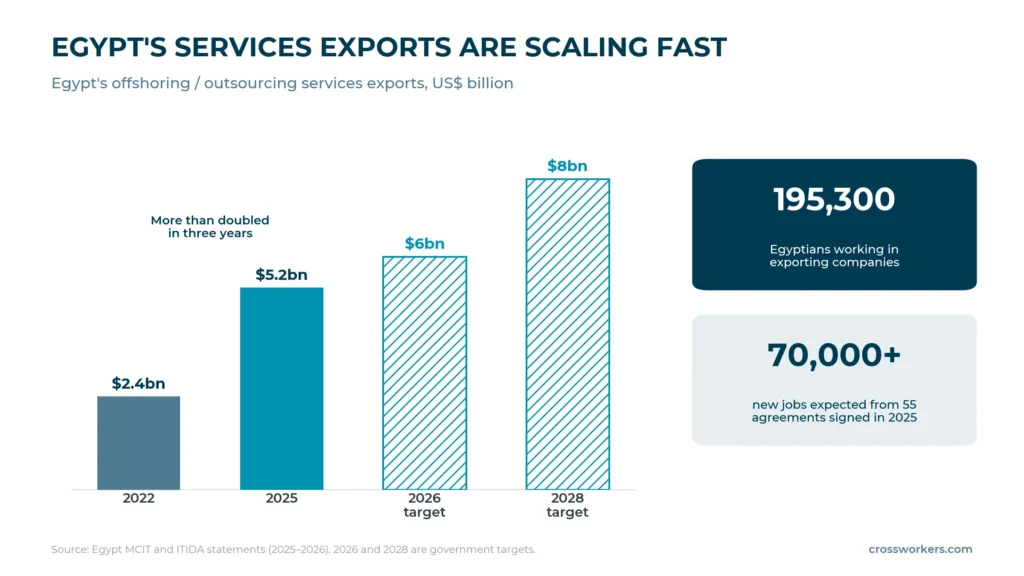
The country’s offshoring services exports reached $5.2 billion in FY2025/26, with around 195,300 Egyptians working in exporting companies across the sector. The work extends beyond traditional customer service into software development, IT services, engineering, research and development, and increasingly AI-enabled services.
At the 2025 Global Offshoring Summit in Cairo, 55 agreements were signed with international and local companies. ITIDA expects those agreements to create more than 70,000 additional jobs over the following three years.
That changes the proposition.
A company looking at North Africa might be looking for customers.
But it might equally be looking for software developers, engineers, support teams, or a regional delivery operation.
North Africa is not one business market
There is a risk in talking about North Africa as if it were one economy. It isn’t.
Different countries are attracting businesses for different reasons.
Morocco has built strong links to European manufacturing and export markets. Egypt combines a large domestic market with logistics, technology talent and a growing international services industry. Tunisia has an established export and industrial base, although investment conditions remain challenging. Algeria offers a sizeable domestic economy and significant energy resources while working to diversify further beyond hydrocarbons.
This distinction matters.
The question for an international company should be:
Which North African market fits what we are trying to achieve?
Where Egypt fits into the picture
Egypt is interesting because companies can approach the market in different ways. It can be a place to sell, build a team, establish local operations, or test an opportunity before making a larger commitment.
And entering Egypt does not necessarily mean starting with a full local operation. Some companies begin with a few employees or a software development team. Others start with local representation, search for partners or customers, and establish an entity once the business case becomes clearer.
That flexibility can make Egypt a practical starting point for companies exploring business in North Africa.
CrossWorkers has been operating in the Egyptian market for 17 years, helping international companies build teams, establish local operations, and navigate the market. If Egypt is one of the markets you are considering, we can help you understand your options and choose the setup that makes sense for your business.

Company Registration in Egypt: What European Businesses Should Know Before Starting
(+45) 70 27 20 40info@crossworkers.com For many European businesses, company registration is the first item on the expansion checklist. But one of the most common mistakes companies make when entering a new market is confusing company registration...

Entering the Egyptian Market: How to Scale Without Early Entity Setup
(+45) 70 27 20 40info@crossworkers.com For many European companies, the traditional playbook for international growth is rigid: incorporate a local legal entity, lease office space, and commit to long-term hiring contracts before the business is...
Europe’s IT Talent Shortage and Why Egypt Is Emerging as a Solution
(+45) 70 27 20 40info@crossworkers.com Across Europe, the IT talent shortage has become one of the most pressing challenges for businesses in 2025. Despite increased investment in education, recruitment, and digital transformation, companies continue...
Phone: (+45) 70 27 20 40 E-mail: info@crossworkers.com
Telefon: (+45) 70 27 20 40
E-mail: info@crossworkers.com